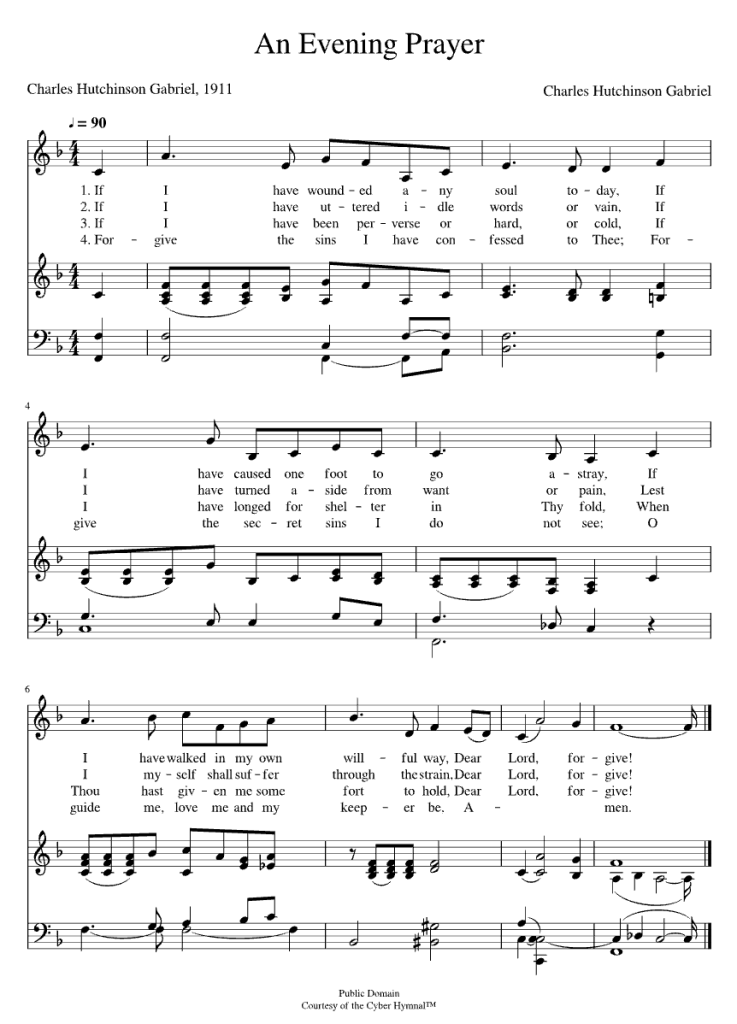
Some hymns are more than music—they are prayers set to melody. An Evening Prayer is one of these. Written with a spirit of humility, it leads us to reflect on the day that has passed and lay our failures before the Lord. Each verse is like a mirror, asking us to examine how we have spoken, acted, and even thought.
The hymn reminds us that the Christian life is not measured only by great acts of faith but also by the quiet moments—whether we loved or withheld love, spoke with grace or carelessness, walked in God’s will or in our own. As we look at its verses, we discover a pattern of prayer that helps us seek both forgiveness and renewal.
When We Hurt Others Unknowingly
“If I have wounded any soul today,
If I have caused one foot to go astray,
If I have walked in my own willful way,
Dear Lord, forgive!”
We often think of sin in terms of great wrongs, but many of our failures are small words or actions that wound without us realizing it. A sharp comment, a neglect of kindness, or simply choosing our own way rather than God’s—these leave unseen scars.
This verse reminds us to ask: Did my words help or harm today? Did my actions point someone closer to Christ, or did I nudge them farther away? The heart that prays this prayer shows humility, willing to confess even when it is not certain of every fault, because it longs to walk in God’s way rather than its own.
Idle Words and Missed Compassion
“If I have uttered idle words or vain,
If I have turned aside from want or pain,
Lest I myself shall suffer through the strain,
Dear Lord, forgive!”
How often do we waste our words on what is empty, careless, or unkind? Jesus Himself said, “But I tell you that for every careless word that people speak, they will give an account of it on the day of judgment” (Matthew 12:36, NASB). Idle speech may feel harmless, yet it reveals the state of our hearts.
This verse also points us to the times we have ignored someone’s need. To turn aside from pain is to close our eyes to the very suffering Christ calls us to bear with others. Compassion requires more than sympathy—it calls for action. And when we turn away, not only does the other suffer, but our own hearts grow harder. In asking forgiveness, we ask God to soften us again, to make us attentive to His call to love.
Coldness of Heart
“If I have been perverse or hard, or cold,
If I have longed for shelter in Thy fold,
When Thou hast given me some fort to hold,
Dear Lord, forgive!”
This verse addresses the quiet sins of the heart—when we become stubborn, unyielding, or spiritually cold. Sometimes, even while enjoying the blessings of God’s care, we neglect the responsibilities He has entrusted to us.
Jesus warned of this in His parable of the talents, where one servant hid what had been given to him rather than using it for his Master’s glory (Matthew 25:25, NASB). It is a sobering reminder: God has given each of us tasks to fulfill, people to serve, and opportunities to reflect His kingdom. To long only for shelter, while ignoring the fort He has placed in our hands, is to miss our calling.
This stanza teaches us to confess not just our wrong actions but also our failures to be faithful stewards of what God has already given.
The Seen and Unseen Sins
“Forgive the sins I have confessed to Thee;
Forgive the secret sins I do not see;
O guide me, love me and my keeper be,
Dear Lord, Amen.”
The prayer ends with the most searching petition of all. We know some of our sins clearly—we confess them in detail. But there are others, hidden even from our own awareness. Pride we don’t recognize, selfishness we justify, attitudes we excuse. David prayed the same in Psalm 19:12: “Who can discern his errors? Acquit me of hidden faults” (NASB).
This final verse teaches us a vital truth: forgiveness is not just about confession, but about trust. We entrust even the unknown corners of our hearts to God, asking Him to reveal, forgive, and cleanse us. And with forgiveness comes guidance. The prayer ends not only with “forgive,” but with “guide me, love me, and my keeper be.” True forgiveness always draws us closer to the Shepherd who both rescues and leads His sheep.
Living the Evening Prayer
An Evening Prayer is more than a hymn to close the day—it is a pattern for the Christian life. It calls us to:
- Examine ourselves honestly in the light of God’s holiness.
- Confess humbly, not only what we know but even what we cannot yet see.
- Seek forgiveness freely, trusting in Christ’s sacrifice.
- Ask for guidance, that tomorrow might be lived more faithfully.
This hymn gathers the whole of Christian repentance into one prayer: our words, our actions, our hearts, and even our hidden faults. Each evening, it teaches us to bring all of these before the Lord who loves us. And in doing so, we find not only forgiveness but also renewal, rest, and the steady hand of the Shepherd guiding us into a new day.
 The Simple Gospel