Throughout history, handwriting has been a powerful means of communication—whether to sign treaties, draft declarations, or pen personal letters. But what happens when the handwriting is not from man, but from God Himself? Imagine the awe, fear, and significance tied to such divine inscriptions. In every great institution—whether industrial, political, or social—there is a guiding hand that directs its destiny. In God’s universe, His hand is not only the guiding force behind the cosmos but also a personal communicator with humanity.
Psalm 19:1 proclaims, “The heavens tell of the glory of God; and their expanse declares the work of His hands.” This verse reminds us that God’s handwriting isn’t limited to parchment or stone; it’s etched into the very fabric of creation. The stars, mountains, and seas all testify to His existence. But beyond nature, there are moments in Scripture where God’s literal handwriting appears—etched on tablets of stone, inscribed on palace walls, and written in the dust by Jesus Himself. These divine writings were not just marks on surfaces—they were declarations of His will, judgments, and messages to humanity.
In this study, we’ll explore several instances of God’s handwriting throughout biblical history, uncovering the lessons and warnings they hold for us today. What do these divine inscriptions reveal about God’s nature, His expectations, and His relationship with mankind? And perhaps most importantly, how should we respond when we encounter the “handwriting of God” in our own lives?
God’s Handwriting in History
1. The Law of Moses
Perhaps the most outstanding event in the Old Testament is when God Himself wrote and delivered the Law of Moses. “When He had finished speaking with him on Mount Sinai, He gave Moses the two tablets of the testimony, tablets of stone, written by the finger of God” (Exodus 31:18). This was the first system of religion under the patriarchal era, with the law engraved on stone to symbolize its permanence and divine authority.
This law was given specifically to the children of Israel, as stated in 2 Chronicles 6:11, “And there I have placed the ark in which is the covenant of the Lord, which He made with the sons of Israel.” Yet, it was meant to last only until Christ came to establish a new covenant. “He takes away the first in order to establish the second” (Hebrews 10:9).
2. The Handwriting on the Wall
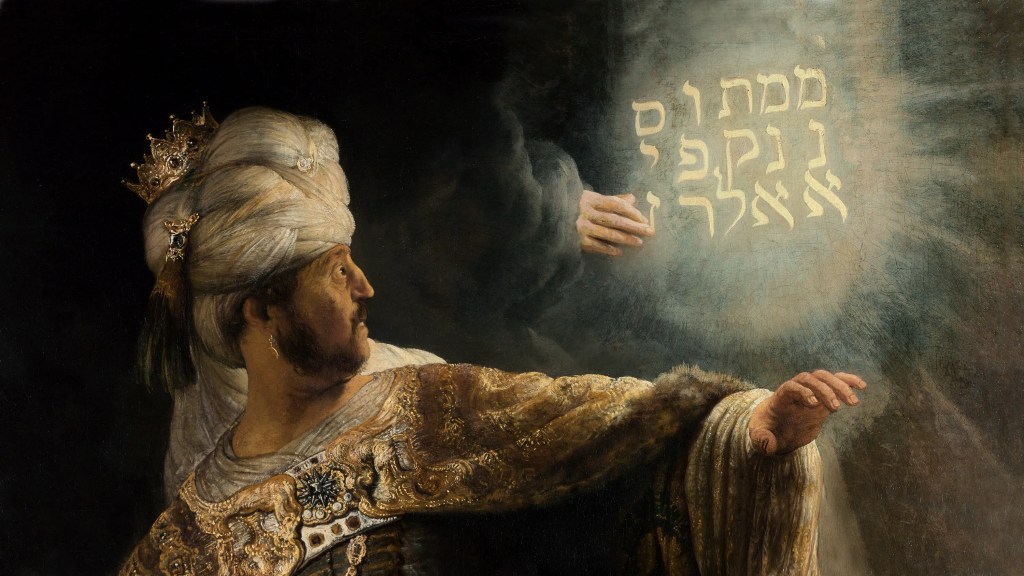
In the book of Daniel, we read of a dramatic event during King Belshazzar’s feast. As the king and his guests desecrated sacred vessels taken from the temple in Jerusalem, “suddenly the fingers of a human hand emerged and began writing opposite the lampstand on the plaster of the wall” (Daniel 5:5). The message was mysterious: “Mene, Mene, Tekel, Upharsin” (Daniel 5:25).
- Mene: God has numbered your kingdom and put an end to it.
- Tekel: You have been weighed on the scales and found deficient.
- Peres (“Upharsin” is the plural form of “Peres”): Your kingdom has been divided and given to the Medes and Persians.
This divine handwriting pronounced judgment upon Belshazzar for his arrogance, idolatry, and disrespect for God. The lesson is clear: God sees the deeds of men and holds them accountable.
3. The Handwriting of Christ
In John 8:6, Jesus encountered a woman caught in adultery, and the Pharisees sought to trap Him by asking if she should be stoned according to the law of Moses. Instead of answering immediately, “Jesus stooped down and wrote on the ground with His finger.” Though the content of His writing is not revealed, His response was powerful: “The one who is without sin among you, let him be the first to throw a stone at her” (John 8:7).
This act of divine handwriting shifted the focus from the woman’s sin to the hypocrisy of her accusers. It demonstrated God’s mercy, grace, and the call to self-examination.
Lessons from the Handwriting of God
1. Self-Examination
Before judging others, we must examine ourselves. “Do not judge, so that you will not be judged. For in the way you judge, you will be judged” (Matthew 7:1-2). The handwriting on the wall was not only for Belshazzar but serves as a reminder to us all—are we living lives that honor God?
2. The Cost of God’s Written Word
The most costly script ever written is the New Testament, sealed with the blood of Christ. “This cup is the new covenant in My blood, which is being poured out for you” (Luke 22:20). It cost the lives of martyrs and required the ultimate sacrifice of Jesus Himself. We often forget that the Scriptures we hold so dearly came at a great price.
3. Our Lives Are Letters
Paul writes, “You are our letter, written in our hearts, known and read by all people; revealing that you are a letter of Christ, delivered by us, written not with ink but with the Spirit of the living God, not on tablets of stone but on tablets of human hearts” (2 Corinthians 3:2-3).
Are we living in such a way that our lives reflect God’s handwriting of grace, truth, and righteousness?
The Handwriting on Our Hearts
God is still writing today, not on stone walls or tablets, but on the hearts of His people. Just as Belshazzar was weighed and found wanting, we too must ask:
- Does my faith balance with the Word of God?
- Is my repentance genuine, beyond mere sorrow?
- Does my life reflect obedience to God’s commands?
Conclusion
The handwriting of God is more than ink on a page or etchings on stone—it’s a divine call to self-reflection, repentance, and transformation. Whether carved into tablets on Mount Sinai, traced by an invisible hand on a palace wall, or written quietly in the dust by Jesus Himself, God’s messages have always demanded a response. They are not relics of the past but living lessons etched into the fabric of human history—and into our hearts.
The question isn’t whether God is still writing today. He is. The real question is: Are we paying attention?
When Belshazzar saw the mysterious writing on the wall, his face grew pale, and his knees knocked together in fear. He didn’t need to understand the language to know it was a message of judgment. In the same way, God’s handwriting is not confined to the walls of ancient palaces—it is written on our hearts. “I will put My law within them and write it on their heart; and I will be their God, and they shall be My people” (Jeremiah 31:33).
Paul reminds us in 2 Corinthians 13:5, “Test yourselves to see if you are in the faith; examine yourselves!” What would God’s handwriting reveal if He wrote a message specifically about your life? Would it be words of approval and faithfulness, or would it echo the chilling verdict given to Belshazzar: “You have been weighed on the scales and found wanting” (Daniel 5:27)?
Today, God’s handwriting is visible in His Word, His creation, and the lives of those transformed by His grace. But the most personal message is the one written on your heart. Are you allowing Him to inscribe His truth, His love, and His purpose there?
Take a moment. Reflect. What would the handwriting of God say about you?
 The Simple Gospel