Introduction: Understanding Hades in Scripture
In early Christian teachings, there’s a clear assertion that when a person dies, they do not go immediately to heaven or hell. Instead, they enter a realm known as Hades, a temporary place of waiting for the resurrection and final judgment. This understanding is based on scriptural references, including the experience of Jesus after His death. Peter, quoting David, stated about Christ, “Because You will not abandon my soul to Hades, nor allow Your Holy One to undergo decay” (Acts 2:27, NASB). This indicates that, during the period when Jesus’ body lay in the tomb, His soul was in Hades, not in heaven.
Similarly, Jesus’ words to the thief on the cross further clarify the nature of this interim state. Jesus said to the repentant thief, “Truly I say to you, today you shall be with Me in Paradise” (Luke 23:43, NASB). This “Paradise” is understood to be a part of Hades, specifically a place of comfort within the spirit realm, distinct from torment but still not the final heaven. Therefore, Hades is not the final destination for souls but a temporary place of holding and separation between the righteous and the wicked until the final judgment.
The Definition and Nature of Hades
The term “Hades” in the New Testament is derived from Greek, meaning “The Unseen.” Consistently, it is described as “The Unseen Abode of Disembodied Spirits,” a realm where souls dwell between physical death and eventual resurrection. This is supported by Jesus’ parable of the rich man and Lazarus, which provides a vivid portrayal of Hades (Luke 16:19-31). In this account, both the rich man and Lazarus enter Hades, yet they experience entirely different conditions.
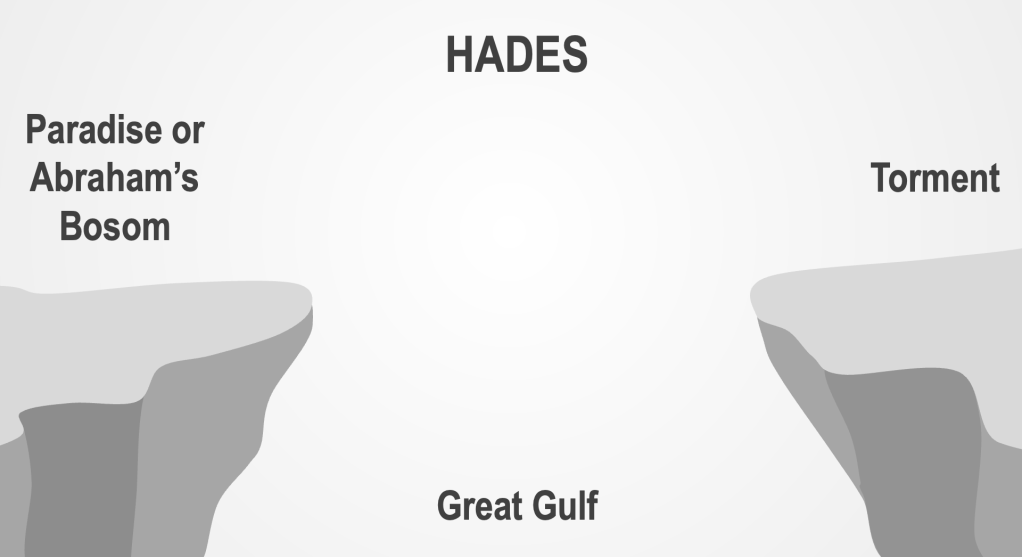
The story describes Lazarus, a poor man who had suffered in life, now resting in comfort “at Abraham’s bosom.” Meanwhile, the rich man, who had lived selfishly, finds himself in a place of torment. A great chasm separates these two areas, preventing movement between them, as Abraham explains, “…between us and you there is a great chasm fixed, so that those who wish to come over from here to you will not be able, and that none may cross over from there to us” (Luke 16:26, NASB). This chasm signifies a permanent separation within Hades, distinguishing the place of comfort from the place of suffering.
Examining Luke 16: Parable or Literal Truth?
A significant debate exists around whether the story of the rich man and Lazarus is a parable or an actual depiction of the afterlife. Traditionally, parables in the New Testament do not include specific names, yet this account uniquely names Lazarus. This detail suggests it could be more than a mere illustration, possibly reflecting real conditions in Hades.
- Use of a Proper Name: This story is the only instance in Jesus’ parables where a character is named, suggesting an intent to convey a literal truth.
- Structure and Language: Unlike typical parables, which start with phrases like, “And He spoke a parable unto them,” this account begins straightforwardly with “There was a certain rich man.” This implies it may not be merely illustrative.
- Purpose of Parables: A parable, by definition, is “an illustration designed to make clear some spiritual obscure truth.” Whether parable or not, this account in Luke 16 vividly teaches about the reality of Hades and the irrevocable separation between comfort and torment after death.
Thus, whether Jesus intended this as a parable or a literal description, the story conveys profound truths about the state of souls in Hades, emphasizing that each person’s choices in life determine their condition in the afterlife.
Key Teachings about Hades
The passage in Luke 16 and other scriptures highlight several crucial aspects of Hades:
- The Soul Continues After Death: Hades affirms the soul’s survival beyond physical death. The rich man and Lazarus each retain awareness and identity, experiencing either comfort or suffering.
- Dual Compartments of Hades: The rich man and Lazarus illustrate two distinct areas within Hades—a place of comfort (often associated with Abraham’s bosom or Paradise) and a place of torment. The rich man, in agony, can see Lazarus at a distance, yet a “great chasm” permanently separates them.
- Implication of Judgment: This separation in Hades reflects divine justice, where the choices made in life influence one’s state in death. However, it remains a temporary condition, not the final judgment, which will determine eternal destiny.
Objections to Hades as an Intermediate State
Some argue against the view of Hades as a temporary realm, suggesting that believers go directly to heaven upon death. However, several points challenge this perspective:
- Scriptural Language: The Greek term “Gehenna” is used in the New Testament for the final place of punishment, distinct from Hades. In Luke 16, Hades is not used to signify eternal punishment but rather an intermediate abode for souls awaiting judgment.
- Peter’s Use of David’s Prophecy: In Acts 2:34, Peter points out that David did not ascend into heaven, affirming that even the righteous awaited the fulfillment of resurrection and judgment. He argues, “For it was not David who ascended into heaven” (Acts 2:34, NASB), supporting the idea that souls do not enter heaven immediately upon death.
- Judgment’s Necessity: If souls went directly to their final destinations upon death, it would negate the purpose of a future judgment. Scripture, however, emphasizes that judgment is essential for a formal declaration of each person’s destiny. As stated, “The Lord knoweth them that are His” (2 Timothy 2:19, NASB), indicating that God’s knowledge of the righteous is secure, yet formal judgment still awaits.
The Judgment’s Role
The concept of Hades reinforces that judgment is not merely about determining guilt or innocence—God already knows the heart of every individual—but rather serves as a formal pronouncement of each soul’s final destination. Jesus’ depiction of the final judgment in Matthew 25:31-46 describes the moment when “the Son of Man comes in His glory” and formally separates “the sheep from the goats.” This judgment scene emphasizes that God’s decision is based on a lifetime of choices and that Hades is merely a precursor to this final, eternal state.
Conclusion: The Temporary Role of Hades
Hades serves as a temporary realm where souls reside in a state of waiting, either in comfort or in torment, separated by an unbridgeable chasm. It is not the ultimate destination, as scripture emphasizes the future resurrection and judgment, where final destinies will be revealed and affirmed. The reality of Hades challenges believers to consider the weight of their choices, knowing that life after death includes this interim period before the final judgment. Hades reminds us of the gravity of our earthly lives, as our decisions have eternal consequences.

 The Simple Gospel